In the Post, Not the Inbox: A Small Mailer That Earns a Second Look
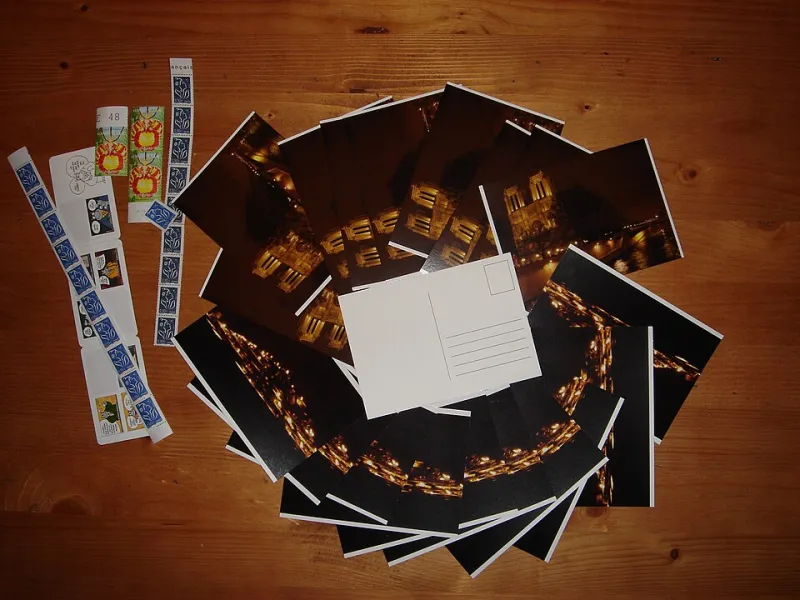
Photo: Alexandre Duret-Lutz from Paris, France, CC BY-SA 2.0, via Wikimedia Commons
Every few weeks someone asks how to get more eyes on their work. The usual answer is another platform, another profile, another algorithm to please. I would like to suggest a stamp instead.
Why a postcard still earns its place
Not because print is magic. Because attention is finite. An email lands in a queue alongside forty others and gets filed under 'later', which is a polite word for never. A postcard lands on a doormat. Someone picks it up, turns it over, and gives it two seconds. That is two seconds more than most PDFs get.
In 2026 the novelty is not digital. It is physical. A small mailer is cheap enough to test, slow enough to feel considered, and specific enough to be remembered. It also has a useful side effect: you have to decide what you actually do, because there is no room to waffle.
Three pieces, one line, no essay
The temptation is to cram everything onto the card. Resist it. Three images is plenty. Choose work that hangs together rather than work that shows range. If someone cannot tell what you do from the front of an A6 card, the card is doing too much.
On the back, one line. Not a paragraph. Something like: 'Illustration and packaging design for food and drink brands.' Or: 'Web design for small UK charities.' Then your name, your site, your email. A QR code is fine but optional; a short URL is more reliable and less faff for the recipient.
Keep the design quiet. A white or off-white background, good margins, and images that are legible at postcard size. If you shrink a detailed image until it looks like static, it is not the right image. Test it by holding the proof at arm's length.
Build a list of twenty, not two hundred
Twenty is the magic number because it forces you to be specific. Choose UK clients, studios, art directors, or commissioners you would genuinely like to work with. Not 'anyone who might need design'. Actual names at actual addresses.
Use a spreadsheet. Columns for name, organisation, address, why them, date sent. Research the address from the organisation's public contact page. Do not buy a list. Do not scrape a hundred emails and turn them into labels. This is not a mailshot; it is a small, deliberate introduction.
For business addresses, posting a relevant, low-volume piece of professional mail is generally considered acceptable under UK direct marketing rules, but keep it sensible: business addresses only, relevant to the recipient's work, and easy to opt out of future post. If in doubt, ask. Common sense goes a long way here.
Printing without the production drama
A6 (105 × 148 mm) is the classic postcard size and cheap to post. A5 gives you more room but costs more and feels more like a flyer. For a first run, A6 is the safer choice.
Go for 350–400gsm stock. Uncoated or matte is better than high-gloss: it takes handwriting, it does not glare under an office light, and it feels nicer in the hand. A short run of 50 is plenty for a list of 20, with spares for mistakes and future sends. UK printers such as Printed.com, Moo, or a local independent will do a decent job for roughly £20–£40 on a short run. Order one proof before you commit. Check the colour, the crop, and whether your contact details are actually readable at 8pt.
Postage, envelopes and the boring bits
You can post a card naked, but it will get scuffed and stamped on. An envelope is kinder and looks more deliberate. A C6 envelope takes an A6 card perfectly. Write the address by hand if you can; printed labels make it look like a mailshot, because it is one.
Royal Mail second class is fine. This is not urgent. Weigh the envelope if you are unsure, but a single card in a C6 envelope is a standard letter. Include a return address on the back of the envelope. Post in small batches rather than all at once, and avoid the Christmas post if you want it to arrive before Easter.
The follow-up that is not a chase
Do not email to ask whether they got it. That turns a nice object into a chore. Wait a fortnight, then send a short note that references the card and asks one specific question. Or send nothing and let it sit on their desk. The point is to be remembered, not to close a sale in a week.
Keep it going
A postcard portfolio works best as a habit, not a stunt. Twice a year is enough. Each time, swap in one new piece and update the one-line pitch. Track who replies, who asks for a link, and who goes quiet. Over two years you will have a small, warm list of people who recognise your name when it appears in their inbox. That is worth more than another platform profile.
Start with twenty. Print fifty. Post them on a Tuesday. See what comes back.